
If you’ve been told you have a “torn meniscus”, the first reaction is usually “do I need surgery?”. The honest clinical answer: often not, and the surgical decision has shifted substantially in the last decade based on better evidence.
This article is a clear guide to meniscal tears: what they are, when surgery is the right call, when conservative care fits, and where Osteopathy contributes.
For the broader knee picture, see our knee pain page.
What the meniscus actually is
Each knee has two menisci: C-shaped pads of fibrocartilage that sit between the femur (thigh bone) and tibia (shin bone). One on the inside (medial meniscus), one on the outside (lateral meniscus). Their jobs:
- Shock absorption during weight-bearing.
- Load distribution across the knee joint surfaces.
- Joint stability, especially during rotation.
- Lubrication and joint nutrition.
The menisci have limited blood supply. The outer rim has some; the inner two-thirds has very little. This matters for healing: tears in the well-supplied outer rim can sometimes heal naturally; tears in the inner avascular zone often don’t.
How meniscal tears happen
Two distinct patterns:
Acute traumatic tear (younger, active patients). A specific event: a twisting injury during sport, a sudden squat-and-rotate movement, a contact injury. The patient often hears or feels a pop, the knee swells over hours to a day, and specific movements (deep squat, twisting on a planted foot, getting in/out of a car) trigger pain.
Degenerative tear (older patients). No specific event. The meniscus has gradually worn through over years. Often part of a broader picture of mild osteoarthritis. Pain pattern: gradual onset, worse with prolonged use or specific positions, sometimes with mild swelling.
The two patterns often have different surgical answers, and that distinction matters.
When surgery is the right call
The standard “torn meniscus → surgery” thinking has substantially evolved. Current evidence-based answers:
Surgery (arthroscopic meniscectomy or repair) is more strongly indicated when:
- Mechanical symptoms: locking (knee won’t fully extend), catching, or clear “something giving way”.
- Acute traumatic tear in a young active patient with significant functional loss.
- Specific tear patterns that won’t heal and are clearly the dominant pain driver (bucket-handle tears, displaced flap tears).
- Failure of conservative care for 3-6 months in a clear traumatic case.
Surgery is less strongly indicated (often actively discouraged) when:
- Degenerative tears in older patients without mechanical symptoms. Multiple high-quality trials (FIDELITY, METEOR) showed surgery for degenerative meniscal tears works no better than placebo or sham surgery. Conservative care is the right first call.
- Asymptomatic tears found incidentally on imaging. Common in middle-aged-and-older adults; treating them doesn’t reliably help.
- Tears in the avascular inner zone in older patients where the pain isn’t clearly mechanical.
The shift has been substantial: NZ orthopaedic practice has moved meaningfully toward conservative-first management for degenerative tears, in line with international evidence.
What conservative care looks like
For most meniscal tears that don’t have a strong surgical indication, conservative care follows a structured pathway over 8-16 weeks:
Phase 1 (weeks 1-3): settle and protect. Pain and swelling control. Avoid movements that clearly aggravate (deep squat, twisting). Hands-on work to release surrounding muscle tension and restore basic movement. Gentle range-of-motion work.
Phase 2 (weeks 3-8): rebuild quad and hip strength. The quadriceps muscles are the major load-shock-absorbers for the knee. Weak quads transfer more load through the meniscus. Targeted strength work for quads, glutes, and hip stabilisers reduces the load the meniscus has to absorb.
Phase 3 (weeks 8-16): graded return to function. Progressive loading toward the patient’s specific activities. Sport-specific or work-specific patterns. Continued hands-on care as needed.
The trajectory: most patients with meniscal-tear pain that responds to conservative care notice meaningful improvement within 6-8 weeks; full return to activity often around 12-16 weeks.
Where Osteopathy fits
For meniscal tears, Osteopathy is one piece of a multi-piece picture:
What we contribute:
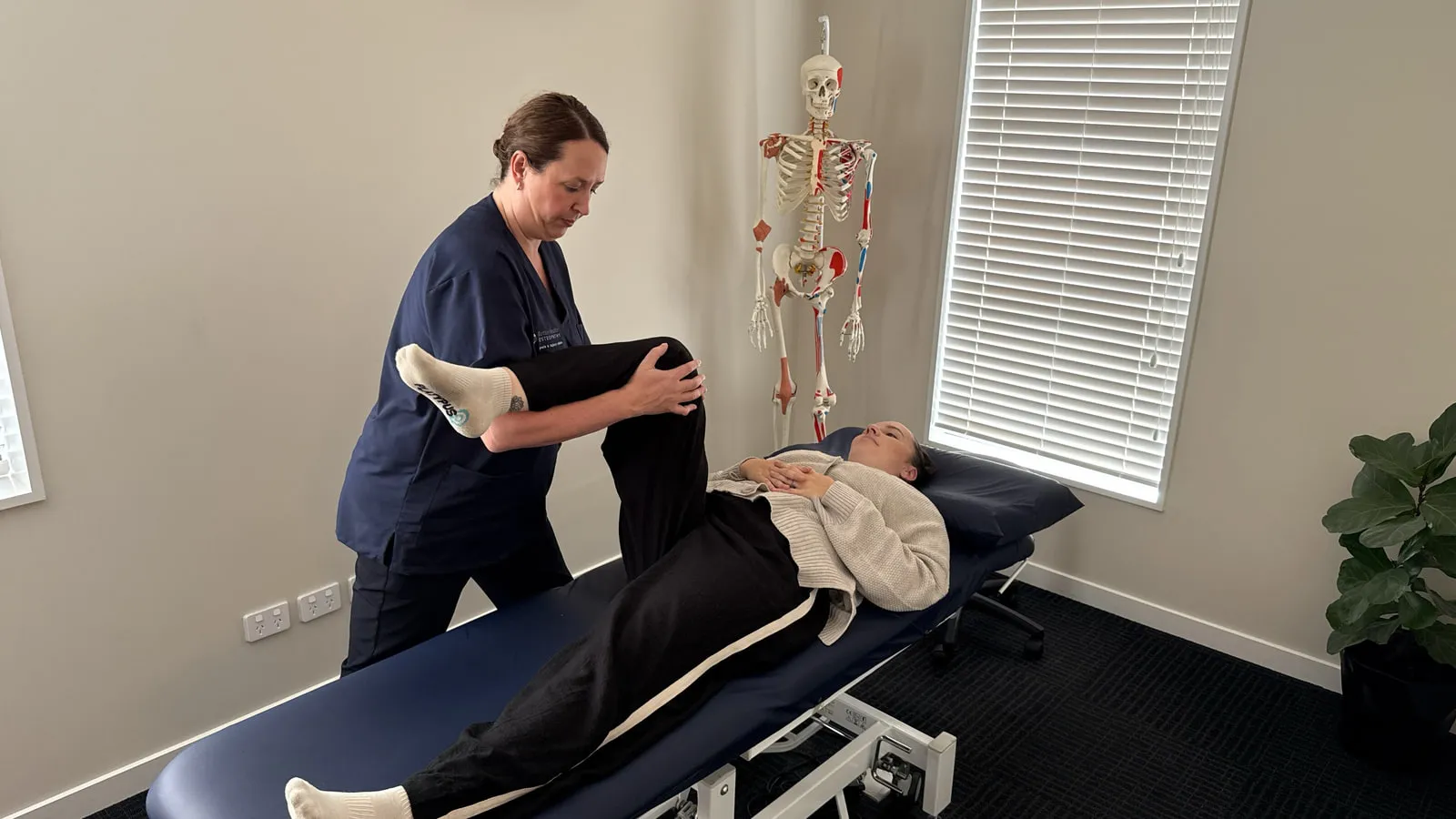
- Hands-on work for the surrounding knee, hip, and ankle structures that often get tight or under-activated in compensation.
- Assessment and treatment of compensatory patterns in the unaffected leg, lower back, and hips.
- Calibrating the rehab progression: knowing when to push, when to back off.
- Coordination with GP, sports physician, or orthopaedic surgeon for cases where surgery may be the right call.
What we don’t do:
- Diagnose meniscal tears via imaging (we work from imaging done by GP, sports physician, or orthopaedic referral).
- Perform meniscal surgery.
- Replace specialised post-surgical rehabilitation (physiotherapy is typically the lead specialty for surgical rehab).
For most cases, the pathway is: GP or first-contact clinical assessment → if surgery is being considered, orthopaedic referral and MRI; if conservative care is appropriate, structured rehab with Osteopathy and/or physiotherapy.
Recovery timelines
- Mild conservative cases: 8-12 weeks for substantial improvement; 3-4 months to full strength.
- Moderate conservative cases: 12-16 weeks for substantial improvement; 4-6 months to full activity.
- Post-surgical (arthroscopic meniscectomy): 6-12 weeks for full recovery typically.
- Post-surgical (meniscal repair): longer, often 4-6 months because the repair has to heal.
These are typical; individual variation is wide.
ACC and meniscal tears
Meniscal tears caused by a clear injury event are usually ACC-eligible. Degenerative tears without an injury event typically aren’t, though there can be grey areas (an injury overlay on a degenerative meniscus). The ACC and Osteopathy guide covers the funded-care side, including how surgical referral works under ACC.
Booking with us
If you’ve been diagnosed with a meniscal tear or have knee pain that fits the patterns described, book online or call us on 0800 67 77 00. We’ll work through which category your case fits and what the right next step looks like.
Related reading
- Knee pain condition page for the broader knee picture.
- Torn ACL: is surgery required? for the related cruciate-ligament decision.
- How do injuries heal for the recovery framework.