
You get headaches that start at the back of your skull, often on one side, and spread forward. They flare with neck movement or after a long day at your desk. They feel different from migraines and from “ordinary” tension headaches. Pain relief helps a bit, but it’s not a fix.
What you’re probably describing is a cervicogenic headache: a headache pattern where the source is in the neck, not the head itself. It’s a real diagnostic category, it’s distinct from migraine and tension-type headache, and it responds well to the right treatment.
This article is a focused deep-dive on the neck-headache connection. For a broader walkthrough of headache types overall, see the headache and migraine condition page. This piece zooms in on the cervicogenic specifically.
What cervicogenic headache actually is
Cervicogenic headache is pain perceived in the head that originates from a structural problem in the upper cervical (neck) spine. The pain is referred from neck structures (joints, muscles, ligaments, nerves) into the head, where you experience it as a headache.
The mechanism: the upper three cervical nerve roots (C1, C2, C3) share neural pathways with the trigeminal system, which supplies sensation to the face and head. Irritation of structures supplied by these upper cervical nerves gets perceived as pain in head regions, not just the neck.
This is well-described in the medical literature, and there’s a formal diagnostic criteria set (ICHD-3, the International Classification of Headache Disorders). It’s a legitimate clinical entity, not just “tension headache from a sore neck”.
The classic pattern
Cervicogenic headaches typically:
- Start at the base of the skull or back of the head, then radiate forward over the top or to the temple
- Are usually one-sided (the same side most of the time, though they can switch)
- Are provoked by neck movement, sustained postures, or pressure on certain points in the neck
- Have an associated reduced range of neck motion, especially rotation toward the painful side
- Can be constant or episodic, often with a baseline ache that flares
- Often come with associated neck or shoulder pain or stiffness
- May include mild dizziness or visual disturbance, but rarely the dramatic aura of migraine
- Don’t typically include the nausea, light sensitivity, and sound sensitivity of full migraine
- Often respond to specific provocation tests during examination (palpation of upper cervical joints reproduces the headache)
The pattern is recognisable once you know what to look for, both for the patient and for the clinician examining them.
How it differs from migraine and tension headache
This is the most useful clinical question, because the management differs.
Migraine typically:
- Severe, often described as throbbing or pulsating
- Comes in episodes lasting 4 to 72 hours
- Often accompanied by nausea, vomiting, sensitivity to light and sound
- May have aura (visual disturbance, tingling, speech change) preceding the headache
- Often comes with a need to lie down in a dark room
- Has a strong genetic component
- Responds to migraine-specific medication (triptans)
Tension-type headache typically:
- Mild to moderate
- Bilateral (both sides)
- Pressing or tightening, “like a band around the head”
- Doesn’t worsen with routine activity
- Doesn’t have nausea, light/sound sensitivity, or aura
- Usually shorter (30 minutes to a few hours)
Cervicogenic headache typically:
- Mild to moderate
- One-sided, starting at the base of the skull
- Provoked by neck movement or position
- Comes with reduced neck range of motion
- Has a clear neck-irritation history (poor sleep posture, recent strain, long desk session)
- Doesn’t include the migraine-specific features
In real life, many people have mixed pictures: some cervicogenic + some tension + occasional migraine. The treatment focuses on the dominant pattern and the most modifiable drivers.
Common triggers
Things that flare cervicogenic headaches:
- Sustained neck postures: long desk sessions, looking down at a phone, driving, reading
- Poor sleep position: pillows that are too high or too flat, sleeping face-down with the head turned
- Recent neck strain: a “slept funny” pattern, a quick movement that twinged the neck
- Stress and muscle tension building up in the upper traps
- Eye strain from screens or uncorrected vision
- Jaw clenching that loads the upper cervical spine indirectly
- Old injuries (whiplash, falls) that left the upper cervical spine more sensitive
The common thread: anything that loads or irritates the upper cervical spine for a while.
What helps
The strongest evidence is for a combination of:
Manual therapy (Osteopathy, physiotherapy, chiropractic). Multiple studies show significant short-term and medium-term reductions in headache frequency and intensity with hands-on care for cervicogenic headache. The technique varies (mobilisation, manipulation, soft tissue) but the effect is consistent.
Specific neck exercises, particularly:
- Deep cervical flexor activation (the small muscles at the front of the neck that often switch off with chronic pain)
- Range-of-motion work for the upper cervical segments
- Strength endurance work for the deep neck muscles
- Postural retraining
Posture and ergonomics:
- Screen setup at the right height (top of screen at eye level)
- Regular movement breaks (every 30 to 45 minutes)
- Pillow setup that supports the neck position you sleep in
- Phone use with the head up, not down
Stress and sleep:
- Both genuinely affect headache frequency
- Whatever your stress-management approach is, it helps here
What we don’t recommend:
- Long-term frequent pain relief without addressing the underlying pattern (paracetamol or ibuprofen daily for weeks can cause medication-overuse headache, which compounds the problem)
- Continuing to push through with no plan
- Imaging without red-flag features (rarely changes management for ordinary cervicogenic headache)
What to expect at your first visit
A first visit takes 30 minutes. We:
- Take a careful history to identify the headache pattern: cervicogenic, tension, migraine, or mixed.
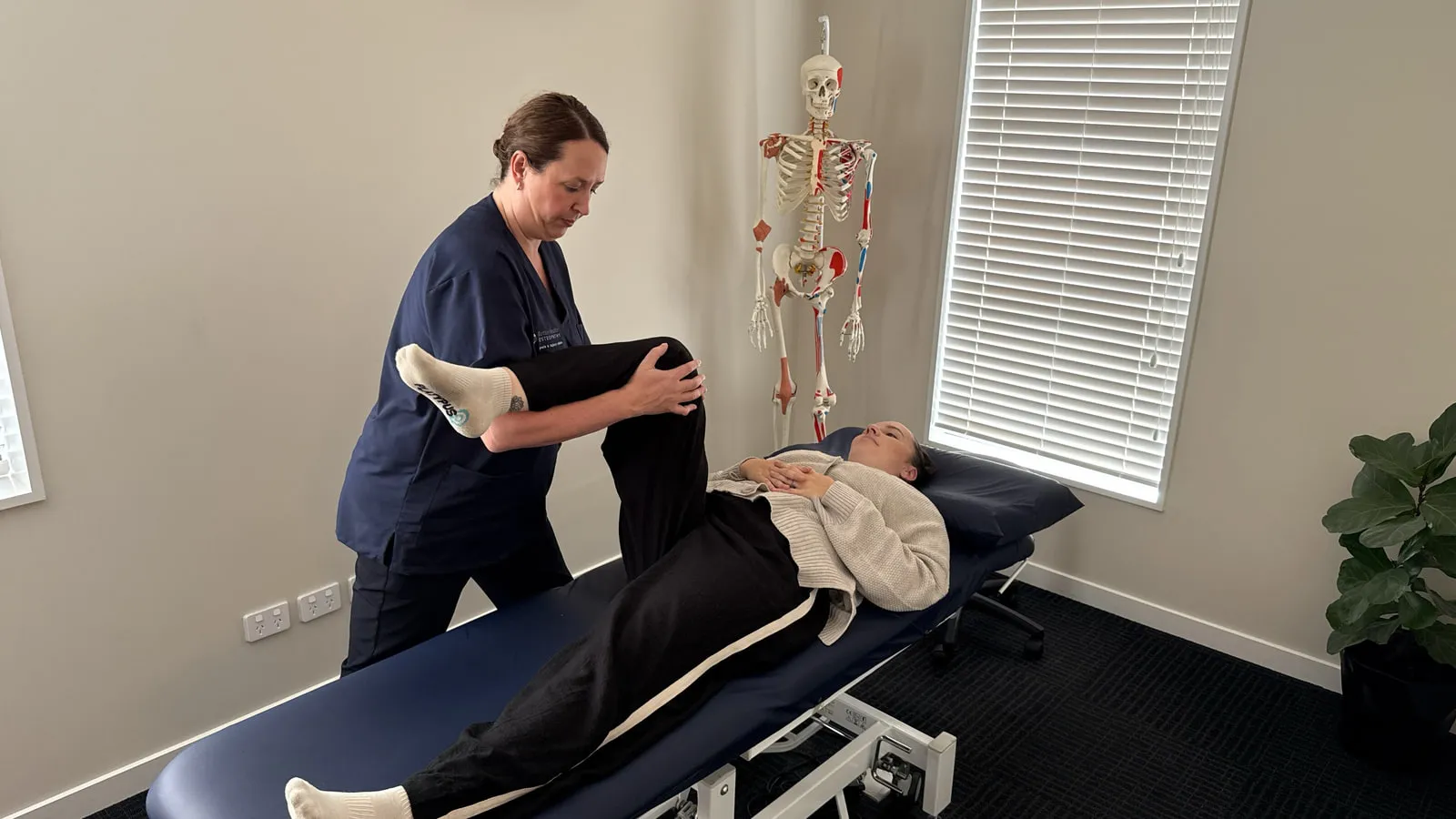
- Examine the neck thoroughly, including specific cervicogenic provocation tests, range of motion, and the upper cervical joints.
- Screen for red flags: features that suggest a different cause (vascular, neurological, systemic).
- Treat with hands-on work targeted at the cervicogenic drivers: soft tissue release, joint mobilisation, sometimes higher-velocity adjustment if appropriate.
- Plan: specific exercises to start at home, posture and sleep advice, expected recovery arc.
Many people leave the first visit with noticeably less headache. The bigger gains come over the following 2 to 4 weeks as the rehab work compounds.
How many sessions?
For typical cervicogenic headache:
- First-time presentations (recent onset, clear trigger): often 3 to 5 sessions over 4 to 6 weeks.
- Established patterns (months or years of recurring headaches): 6 to 10 sessions, often spaced out as the home work builds capacity.
- Mixed patterns (cervicogenic plus migraine plus stress): a longer arc, sometimes alongside GP input for migraine medication.
Frequency reduces as you improve. Early on, weekly is common. By weeks 4 to 6, fortnightly. Eventually monthly check-ins, then as-needed.
Red flags: when headache needs urgent assessment
Most headaches are benign. A small minority need urgent medical assessment. Get help promptly if:
- A sudden severe (“thunderclap”) headache unlike anything you’ve had before
- Headache with fever, neck stiffness, photophobia (possible meningitis)
- Headache with new neurological symptoms: weakness, slurred speech, vision change, balance loss
- Headache after a head injury, especially with confusion, drowsiness, or vomiting
- Headache that’s steadily worsening over days or weeks rather than coming and going
- New headache pattern in someone over 50 with no prior headache history
- Headache with unexplained weight loss, fever, or feeling acutely unwell
These are uncommon with cervicogenic headache but worth knowing.
What you can do at home
While you book in, three things that often help:
- Heat on the neck and upper traps for 15 to 20 minutes, once or twice a day.
- Gentle neck mobility work: small rotations, side bends, chin tucks. Do these often, not hard.
- Reduce sustained desk time: every 30 to 45 minutes, get up, look around, do a few neck movements.
If your headache pattern is cervicogenic, these alone often produce noticeable change within a week. They don’t replace targeted treatment, but they layer well with it.
Booking with us
If you’d like to book in, book online or call 0800 67 77 00. If your headaches are recent and follow an injury event (whiplash, fall, sport contact), the ACC and Osteopathy guide covers the funded-care side.
Related reading
- Headache and migraine: full condition guide for the broader headache picture across types.
- Neck pain for the neck-side patterns that drive cervicogenic headaches.
- Whiplash recovery if your headaches started after an accident.
- Slept funny on my neck for the acute neck-pain pattern that often comes with one-off cervicogenic flares.