
If you’ve been told you have a hip labral tear (often after months of niggling groin or front-of-hip pain, sometimes after an MRI), the first reaction is usually a mix of relief at having a name for it and worry about what it means. The honest clinical picture is more nuanced than the diagnosis suggests.
This article is a focused guide to hip labral tears: what they actually are, why they show up, when they need surgical input, and where osteopathic care fits.
For the broader hip-pain picture, see our hip pain page. This article is the deeper view on the labral-tear specific story.
What the hip labrum actually is
The hip joint is a ball-and-socket: the head of the femur (thigh bone) sits inside the acetabulum (hip socket) of the pelvis. The labrum is a ring of cartilage that lines the rim of the socket, deepening it slightly and creating a seal around the joint.
The labrum’s jobs:
- Increase the depth and stability of the hip socket.
- Create a seal that helps maintain joint pressure and lubrication.
- Distribute load across the joint surfaces.
- Provide some shock absorption.
A “labral tear” is a disruption to this ring of tissue. The disruption can be mild (a small fray) or significant (a torn flap that displaces).
Why labral tears happen
Three common patterns:
1. Repetitive overload (most common). Activities that repeatedly load the hip into specific positions: deep squatting, kicking, dancing, running with poor mechanics, certain yoga positions held for long periods. The labrum gets pinched between the femoral head and the rim of the socket and gradually frays.
2. Underlying bony shape (FAI). Femoroacetabular impingement (FAI) is a condition where the bony shape of the femur or socket isn’t quite typical, creating pinching of the labrum during normal motion. Many people with FAI never have symptoms; some develop labral tears as a downstream consequence. Often coexists with the next pattern.
3. Single traumatic event. A fall, a sport collision, a slip, a forced rotation under load. Less common as a cause, but does happen.
4. Gradual age-related change. From the 40s onward, labral tissue (like all cartilage) loses some elasticity and becomes more vulnerable. Often shows up alongside early-stage osteoarthritis.
What it actually feels like
Classic patterns:
- Pain in the front of the hip or deep in the groin. Often a “C-sign”: the patient cups their hand around the front of the hip showing where it hurts.
- Pain or catching with specific movements: deep squat, getting in/out of a low car, sitting cross-legged, twisting on a planted foot.
- Sometimes a clicking or catching sensation during certain movements (not all clicks indicate a tear; many hips click harmlessly).
- Stiffness especially after sitting for long periods.
- Pain that’s been around for months, often gradually worsening, often without a clear single starting event.
What it usually isn’t:
- Sharp pain on the outside of the hip (more often gluteal tendinopathy or bursitis).
- Pain that radiates down the leg below the knee (more often back-driven).
- Pain only with high-impact activity that settles immediately on rest (more often muscular).
How they’re diagnosed
The diagnostic pathway is layered:
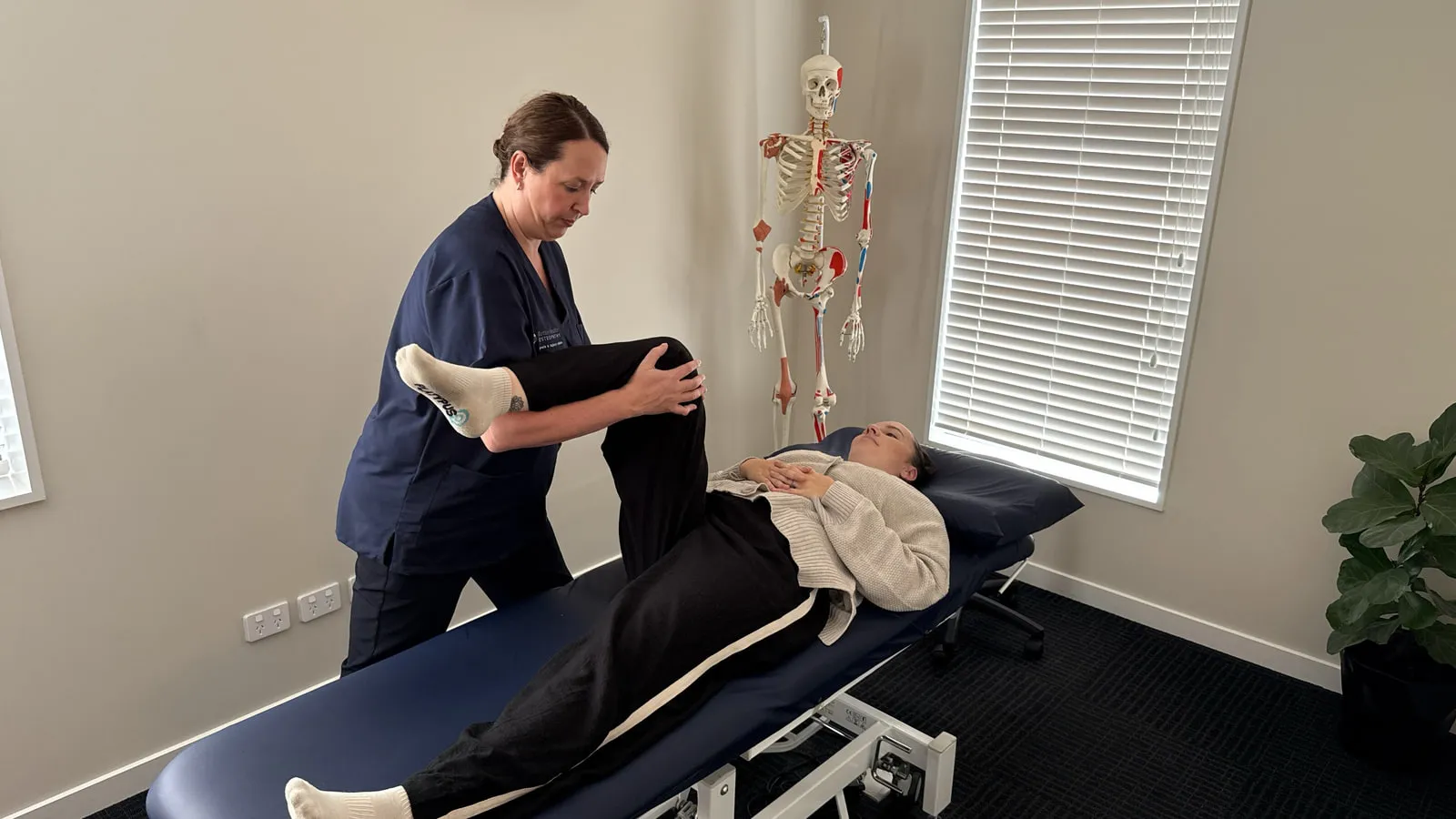
Clinical examination first. Specific tests (FADIR, log roll, Trendelenburg, capsular stretch) help build a picture of whether the hip joint, surrounding tissues, or somewhere else is the driver. A skilled examiner can often narrow the diagnosis confidently before any imaging.
MRI with arthrogram (MRA) is the gold standard for confirmed diagnosis. A regular MRI can miss labral tears; a contrast-enhanced MRA picks up most of them. Plain X-rays show bony shape (relevant for FAI) but not the labrum itself.
Important caveat: imaging can find labral tears in pain-free hips. Studies have shown labral tears in 60-70% of asymptomatic adults over 40. Finding a tear on a scan doesn’t necessarily mean it’s the cause of your pain. The clinical picture has to match.
This is why a good clinician treats the diagnosis as a hypothesis to test against the patient’s pattern, not as the final answer just because a scan reported it.
When surgery is the right call
Hip labral tears are a category where the surgical decision genuinely depends on the case. Surgery (arthroscopic labral repair or debridement, sometimes combined with FAI bony work) is more strongly indicated when:
- There’s a clear traumatic mechanism and a structurally significant tear.
- The patient is active and young (under 40-50), with specific functional demands that aren’t being met.
- Underlying FAI bony shape is contributing and can be addressed surgically.
- Conservative care has been thorough and adequate (12+ weeks of structured rehab) and the trend isn’t moving.
- The labral tear is genuinely the dominant pain driver (clinically and on imaging).
Surgery is less strongly indicated when:
- The tear is incidental on imaging without a matching clinical picture.
- The patient is older with early osteoarthritis (where surgery often doesn’t change long-term trajectory).
- Conservative care hasn’t been tried properly.
- Fearful, deconditioned starting state: rehab capacity needs building before surgical decisions are sensible.
A good orthopaedic surgeon will say similar things. The decision is usually a careful conversation between patient, conservative-care provider (osteopath/physio), and surgeon.
What conservative care looks like
Most hip labral tears that show up in clinic respond to a structured conservative approach over 8-16 weeks. The rough framework:
Phase 1 (weeks 1-3): irritation settle and assess. Identify the movement patterns aggravating the joint. Modify activities. Hands-on work to release tight surrounding tissues (hip flexors, glutes, lower back). Initial graded mobility within pain-free range.
Phase 2 (weeks 3-8): rebuild capacity around the joint. Targeted glute strengthening (especially gluteus medius and maximus), deep hip stabilisers, anti-rotation core work. The aim is to reduce the load shared by the labrum by getting the surrounding muscles doing more of the work.
Phase 3 (weeks 8-16): graded return to function. Progressive loading through patterns specific to the patient’s goals (sport, occupation, daily activities). Continued hands-on care as needed for residual irritation.
Throughout: education on what’s happening, what’s safe, and what isn’t. Many patients have been told they have “torn cartilage” and have stopped doing things they could safely do. Reframing is part of the work.
The evidence for conservative-first management is reasonable: a number of studies show conservative care works comparably to surgery for many patients, with lower risk and shorter recovery.
Recovery timelines
Expect roughly:
- Mild tears in active healthy patients with good rehab adherence: 8-12 weeks for substantial improvement; 4-6 months to feel “back”.
- Moderate tears or patients with FAI: 12-20 weeks for substantial improvement; 6-12 months for full picture.
- Post-surgical (hip arthroscopy): 6-12 months for full activity return; surgeon-driven specifics.
These are typical. Individual variation is wide.
ACC and hip labral tears
In New Zealand, hip labral tears caused by a clear injury event (a fall, a sport tackle, a workplace incident, a motor vehicle accident) are usually ACC-eligible. Cases that came on gradually without a clear event often don’t fit ACC and become private-pay. If FAI bony shape is a major contributor, the ACC pathway may be partial (covering an injury overlay on a non-injury structural picture).
The ACC and Osteopathy guide covers the funded-care side, including how surgical referral and imaging work under ACC if your case heads that way.
Booking with us
If you’ve been diagnosed with a hip labral tear, or you have hip pain that fits the patterns described above, book online or call us on 0800 67 77 00. We’ll work through what’s actually driving your pain, whether the labral tear is the dominant story or part of a wider picture, and what the right next step is.
If you’ve already had a surgical opinion, bring the report. If you’ve had imaging, bring the films. We’ll fit our plan around what’s been done.
Related reading
- Hip pain condition page for the broader hip-pain picture and our overall approach.
- How do injuries heal for the recovery framework underlying conservative care.
- ACC and Osteopathy guide for the funded-care side.