
Osteopathy and chiropractic are often grouped together in patients’ minds: both are regulated manual-therapy professions, both treat a lot of back and neck pain, both are ACC-funded in New Zealand, and both can produce the audible “click” during treatment that the public most often associates with this kind of care.
The differences are real and worth understanding. They sit in scope of assessment, technique mix, and clinical reasoning.
This article focuses on the direct osteopathy-vs-chiropractic comparison. If you’re also considering physiotherapy, start with the three-way comparison instead. New to Osteopathy itself? Our guide to what Osteopathy is is the place to start.
A quick framing
The simplest way to summarise the difference:
- Chiropractic historically centres on the spine and the relationship between spinal joint motion and the nervous system. Treatment leans toward adjustment-style technique (the rapid, often audible “thrust”).
- Osteopathy centres on whole-body assessment and a wider toolkit of hands-on techniques (soft-tissue, articulation, gentle adjustment, fascial work) plus exercise rehabilitation and patient education.
Both fields have evolved. Modern practitioners in both professions often work in similar ways. But the textbook framing still influences how each profession was trained to think.
Training in New Zealand
Osteopaths in New Zealand complete a five-year masters-level qualification (typically a Bachelor of Applied Science followed by a Master of Osteopathy, or an equivalent integrated degree). The curriculum covers anatomy, physiology, pathology, clinical assessment, hands-on technique, exercise rehabilitation, and clinical reasoning. Osteopaths are registered with the Osteopathic Council of New Zealand (OCNZ), which sets professional standards and CPD requirements under the Health Practitioners Competence Assurance Act 2003.
Chiropractors in New Zealand complete a five-year masters-level qualification at the New Zealand College of Chiropractic. The curriculum covers anatomy, physiology, neurology (more depth than osteopathic training, typically), biomechanical assessment, and adjustment techniques. Chiropractors are registered with the Chiropractic Board of New Zealand under the same Act.
Both qualifications are recognised, regulated, and require ongoing CPD. Neither is alternative or unregulated.
Technique: what tends to happen at a session
At a chiropractor, expect the session to centre on adjustment-style technique. The practitioner identifies spinal segments where joint motion is restricted (often described as “subluxation” or “joint dysfunction” depending on the practitioner’s framing) and applies a rapid, controlled thrust to mobilise that segment. The result is often the audible click many patients associate with the profession.
Beyond adjustment, modern chiropractors commonly use:
- Soft-tissue release (instrument-assisted or manual)
- Stretching and mobilisation
- Exercise prescription
- Lifestyle and ergonomic advice
The proportion of session time spent on adjustment vs other techniques varies widely between chiropractors. Some practise a focused-adjustment model where the visit is short and the adjustment is the centrepiece. Others practise a mixed-technique model that’s closer to Osteopathy in feel.
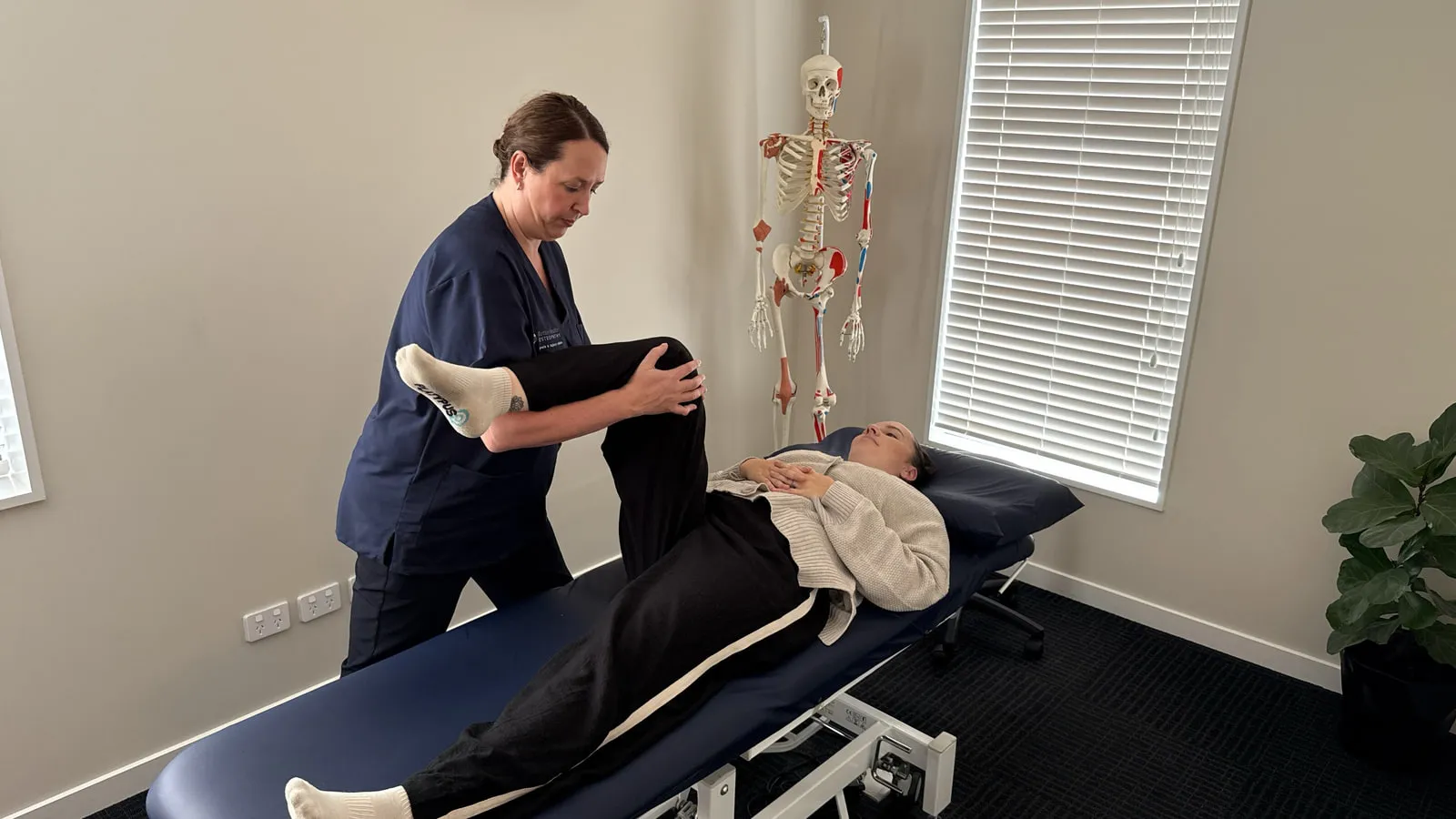
At an osteopath, expect a session that combines several techniques in roughly balanced proportions:
- Soft-tissue work (fascia, muscle, tendon)
- Articulation (gentle joint mobilisation through range)
- Higher-velocity adjustment (similar to chiropractic adjustment) where appropriate and consented to
- Cranial or visceral techniques (in some practitioners’ toolkits)
- Exercise prescription
- Postural and ergonomic advice
The reasoning often draws connections across body regions: a back pain assessment includes the hip and the foot; a neck pain assessment includes the upper back and the shoulder. The sentence “I think the driver of your pain is upstream of where you feel it” is more often heard at an osteopath than a chiropractor.
Clinical reasoning: how each profession frames the problem
This is the most consequential difference, and the one most often hidden from patients.
Chiropractic reasoning, in its most distinctive form, holds that restricted spinal joint motion can have effects on the nervous system, and that restoring spinal motion can restore function. The technique is targeted; the reasoning is targeted.
Osteopathic reasoning holds that pain in one place often reflects how the whole body has compensated for load over time, and that finding and addressing the contributing patterns matters more than any single site. The assessment is wide; the reasoning is systemic.
Modern evidence-based practice in both fields has moved toward a shared framework: pain is multi-factorial, tissue health and load tolerance both matter, and patient engagement plus exercise are critical to durable outcomes. But the historical reasoning still shapes which patterns each profession naturally attends to.
When chiropractic tends to be the stronger first call
- You’ve had a previous chiropractor help you with a similar pattern and want the same approach.
- Your complaint is dominantly spinal and you want adjustment-style technique as the centrepiece of treatment.
- You prefer shorter, more frequent visits over longer, less frequent ones (some chiropractors run a high-frequency, short-visit model).
When Osteopathy tends to be the stronger first call
- The pattern doesn’t fit a single body region (back pain that connects to a stiff hip, headaches with neck and jaw involvement).
- The pattern is recurring rather than acute, and you want assessment of the wider drivers, not just the symptom site.
- You’re working through pregnancy-related pain, postnatal recovery, or paediatric issues. Osteopathy’s gentle, whole-body technique fits these populations.
- You want a session that’s about half hands-on treatment and half education plus home plan.
- A previous chiropractic course of care didn’t resolve, and you want a different angle on the pattern.
ACC and access
Both professions are ACC providers. That means:
- For a musculoskeletal injury, you can usually go directly to your chosen practitioner without a GP referral.
- The first visit lodges the claim. ACC covers a portion of the cost; the patient pays a surcharge that varies by clinic.
- Treatment is reviewed periodically. ACC may ask for a treatment update or extension if care runs long.
There’s no meaningful access difference between Osteopathy and chiropractic in NZ. Whichever you choose, the practitioner can tell you on day one whether your case fits the ACC pathway and what the surcharge will be.
”Will I get cracked?”
This is the question we hear most. Two clarifications:
Yes, both professions can produce the audible click. It’s a normal, harmless side effect of certain joint-mobilising techniques across both fields.
No, the click isn’t “bones going back into place”. Bones aren’t out of place. The sound is the release of gas from a joint capsule when the capsule is briefly stretched. The therapeutic effect of the technique is the joint mobilisation and the brief reduction in surrounding muscle tone, not the click itself. A skilled practitioner can produce the same effect with quieter techniques where the patient prefers.
If you specifically want the higher-velocity adjustment, both fields can deliver it. If you specifically don’t want it, both fields have alternative techniques. Tell your practitioner at the first visit. Patient preference is a clinical input, not an obstacle to overcome.
What about evidence?
For mechanical back pain, neck pain, and tension-type headache, both osteopathic and chiropractic care show evidence of moderate short-term benefit, similar to physiotherapy and other manual-therapy approaches. The evidence base for both fields has grown substantially since the early 2000s.
For more specific conditions (radiating leg pain, headaches with multiple drivers, recurring shoulder issues), the evidence varies. The honest answer: for many musculoskeletal complaints, either profession can help, and the practitioner’s individual skill and the fit with your situation matters more than the profession label.
Choosing well
For most patients, the practical default looks like this:
- Spinal pain you want addressed with adjustment: chiropractor.
- Whole-body or recurring pattern: osteopath.
- Recent injury, hands-on care wanted: either one.
- Pregnancy, postnatal, paediatric: osteopath.
- Tried one for three to four sessions without progress: switch to the other.
If you’ve tried both at different times in your life and one consistently helped more, that’s good evidence to lean on it. Bodies and presentations vary, and what works for someone you know may or may not be the right fit for you.
Booking and what to expect
If you’d like to book with us, book online or call 0800 67 77 00. ACC claims are lodged at your first visit; no GP referral is needed for the vast majority of injuries. We’ll happily recommend a chiropractor colleague if your situation fits theirs better; that’s part of doing this honestly.
Related reading
- The three-way comparison covers osteopaths, chiropractors, and physiotherapists side by side.
- The osteopath vs physiotherapist comparison goes deeper on the osteo-vs-physio question, particularly relevant in NZ where physio is the cultural default.